Beyond the professional: What we learned from The Empathy Exchange [Part 2]

By Clare Woodward and Suzanne Martin
The Empathy Exchange, a Significant Insights editorial series created by Clare Woodward and Suzanne Martin, explores the role of empathy in research and the relationships that shape our industry. Through personal stories and honest reflections, the series asks whether empathy is under threat in an increasingly pressured, technology-driven world, and what we can do about it.
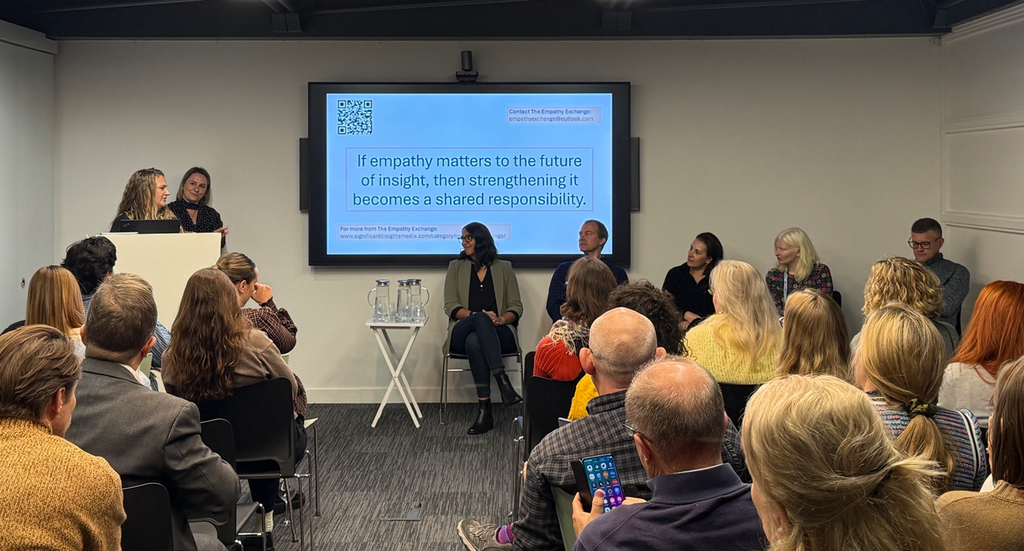
In November, we brought those conversations to life at our first Significant Insights event, hosted by Opinium in London. Having explored why we need to see the person behind the professional in Part 1, Clare and Suzanne now turn their attention to the practical lessons from the evening. In this concluding article, they explore how small changes in our everyday behaviour can help build stronger, more trusting and more human working relationships.
Putting empathy into practice
In Part 1, we explored why empathy matters in research and in the ways we work together, why we need to see the person behind the professional, and how industry pressures are making it harder to do so.
Here, we turn to suggestions from the panel discussion on how we can put empathy into practice: listening before solving, sharing with care and making empathy visible in everyday behaviour.
Small actions, lasting effects
Across the evening, small actions revealed a common thread: noticing what someone else needs and making room for it. Whether by acknowledging our own limits, offering practical help or having an honest conversation, small actions can make a big difference to how people feel.
- A leader admitting they do not have everything under control.
- A colleague saying they are burnt out and need time away.
- An agency partner taking responsibility for a presentation to help a grieving client.
- A team making time for honest conversation rather than filling every hour with activity.
- A client explaining why a proposal was unsuccessful.
Some of these moments take minutes but may be remembered for years. They influence whether somebody feels able to ask for help, whether they trust a leader, whether a client and agency develop a genuine partnership, and whether a difficult experience creates loyalty or disconnection.
Listening instead of solving
Perhaps one of the simplest ideas from the evening was also one of the most useful:
WAIT: Why Am I Talking? As researchers, we know how to ask questions and listen. Yet in everyday relationships, we can find ourselves listening to respond rather than to understand.
If we have asked somebody how they really are, why are we the ones doing the talking?
Reassurance, advice or a similar story may be well meant, but offered too quickly, they can shift attention away from the speaker. Sometimes the most useful response is to ask how somebody really is, then stop talking. That takes attention, curiosity and patience, not a new organisational programme.
Openness needs boundaries
The case for greater openness is compelling. When leaders acknowledge that they are finding something difficult, do not have every answer or have needed support themselves, it can give others permission to be honest too.
Making space for others also means thinking carefully about what we share ourselves. One of the most thoughtful discussions of the evening explored that balance: where openness ends and oversharing begins.
Sharing too much can burden colleagues or crowd out their experiences. Some personal details may simply not be appropriate for a professional environment. Leaders, in particular, have a balance to strike.
Three questions can help: Is this the right time? Is this the right place? How much is appropriate to share? The aim is appropriate vulnerability, not disclosure for its own sake. Nobody should feel obliged to share more than they want to.
Purpose matters too. Is sharing building understanding and trust? Or is it asking someone to provide support they are not equipped to give? Sometimes acknowledging difficulty is enough; further detail can wait until the other person chooses to ask.
There is no perfect formula. But saying something can often be more human and helpful than maintaining a professional mask that everybody can already see through.
Empathy is demonstrated by behaviour, not language
Appropriate openness helps people see the human behind the role. But our panel also raised an important challenge: empathy must be demonstrated through our behaviour when someone needs it, not simply through our language or what we claim to value.
We have become increasingly fluent in the language of empathy, inclusion and wellbeing. We know the right things to say, but the test is whether our actions match those words.
The gap between our words and our behaviour is not always deliberate. Pressures, competing priorities and our own immediate needs can lead to thoughtlessness. Empathy asks us to step outside our own context and consider someone else’s.
Do we listen when we ask how someone is? Do we respect their time, explain difficult decisions and notice when they need help? These everyday actions determine whether people experience the empathy we talk about.
This was an exchange, not an endpoint
The Empathy Exchange was never intended to be a one-off conversation. No single panel, organisation or event has all the answers. The future of empathy in our industry has to be shaped by perspectives from across research, including clients, agencies, partners, practitioners and leaders.
Our first event reinforced the need to keep talking and exploring the experiences that shape us as people. It also highlighted the power of human connection and strengthened our desire to explore this topic further. Our next step is a series of interviews over the coming weeks and months, giving panellists more space to share their stories and more people the chance to hear them.
Meanwhile, choose one small action to try: leave room for someone to speak, offer practical help or explain a decision rather than leave colleagues wondering.
The Empathy Exchange has started. Now we need to keep the exchange going.
We’d love to hear your ideas. If you would like to contribute to the conversation, please contact us at empathyexchange@outlook.com.