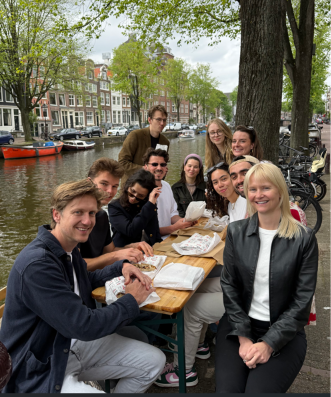
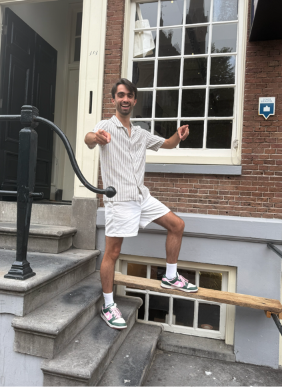
30Under30 Nominee: Steve Serra

Great to hear from Global 30 Under 30 Nominee, Steve Serra, who works as a Customer Delivery Manager at Tellet. Together with the international team, Tellet are based in Amsterdam. Steve is responsible for managing projects with clients, mostly research agencies, from all over the world. More recently, Steve has also become the Product Lead for Tellet Embed, which brings part of Tellet’s solution, AI-moderated qualitative research, to quantitative research.
How did you find your way into research, data and insights?
To be fair, it was never really the plan. I started working at Respondenten.nl, which was acquired by Norstat in 2023, while I was still a student. I began in the call centre, where I was essentially putting together the puzzle of inviting the right profiles to research interviews.
When Norstat acquired Respondenten.nl, I became Team Lead for the student workers. I trained the call centre team while getting used to new systems and colleagues, as another research office in Hoorn was acquired by Norstat around the same time.
After my time as Team Lead, I went on an exchange programme. When I returned, Norstat immediately welcomed me back as its new Project Manager. This was when I started working closely with clients for the first time.
After Norstat, I moved to Sweden to complete my master’s degree. When I returned, Yvette Huitema, formerly Managing Director at Norstat NL, contacted me and said there might be a job opening for me at Tellet. That is how I ended up where I am today and I am really happy to be working with such fantastic people.
A big thank you to Yvette for connecting me with Tellet. When I heard what Tellet was doing, I had no doubt that I wanted to be part of its rapid growth.

What part of your work are you most proud of and why?
I have only been working at Tellet for half a year, but I am already really proud to have contributed to Emily Walsh’s study for SeeResearch. It is a health and wellness study and it was also the first time SeeResearch had used the Tellet solution.
I was assigned as their contact throughout the project, which developed into a really positive collaboration. I enjoyed working closely with Emily and supporting her by sharing tips and tricks to help her get the most out of Tellet.
Seeing the study receive recognition afterwards made it even more special. Emily was nominated for the Young Society Awards at ESOMAR for the work and ultimately came second. Being able to play a part in a project that received that kind of recognition so early in my time at Tellet is something I am really proud of.
What have you learned that you wish you had known at the start of your career?
One thing I have learned from working in the market research industry is how empathetic and communicative its people are. When I began working full-time in a customer-facing role, I was a little nervous because I wanted to do everything right for the client. However, I quickly realised that this was an unrealistic expectation.
Especially since joining Tellet, I have gained confidence by working more pragmatically rather than being too perfectionistic. I have learned that you do not always need to have the perfect answer immediately. Being transparent, thinking alongside the client and finding a solution together often result in a much stronger relationship.
This is also why I think people are so important in market research. Research thrives through a genuine human lens, while technology and AI, and therefore Tellet, can provide valuable support in gaining deeper insights. Ultimately, however, it is still up to people to interpret those insights and decide what to do with them. I think that is the magic of research.
What excites you most about the future of insights and what would you like to help change?
What excites me most is that AI enables us to conduct qualitative research on a much larger scale. In the long term, I think there will be far less distinction between quantitative and qualitative research, as more studies combine both perspectives to gain a deeper understanding of quantitative insights.
For example, AI-moderated qualitative research can be incorporated into quantitative surveys to add an extra layer of depth and understanding.
I think my generation can play an important role in this change because younger people often have a naturally curious mindset. That curiosity is particularly important when the industry is changing as rapidly as it is now, especially under the influence of AI. We should be open to new possibilities and unafraid to experiment with what technology can bring to research.
At the same time, I do not think we should become overly dependent on AI. We need to stay on the front foot as the technology develops, while keeping an open mind and remembering that technology is there to support research, not replace the human perspective. Ultimately, human perception is what makes research so interesting and I believe that will remain the magic of research.
What advice would you give someone starting in the industry today?
Keep an open mind. In this field, you work with many different people, cultures and industries. You can study almost anything, which means you constantly have opportunities to learn about subjects you might never otherwise encounter.
I have found that this also helps me in my personal life. Being curious and open to different perspectives makes you more understanding of the world around you. Especially at a time when conversations can sometimes become less nuanced, I think it is important to keep asking questions, listen to different perspectives and avoid forming opinions too quickly.
Who has helped you along the way?
Laurien Visschedijk at Norstat trusted me when I was very young. She gave me opportunities and responsibilities early on, which played a significant part in shaping who I am today.
Luc Maas, Victoria Chapman and Yvette Huitema at Tellet have also had a major influence on me:
- Luc, for encouraging me to try new things and supporting me in finding a role that genuinely gives me energy.
- Vic, for teaching me practically everything I know about market research and Tellet Embed.
- Yvette, for thinking of me when she heard about a job opportunity at the cool company called Tellet.