A love of people & problem-solving leads to insight careers
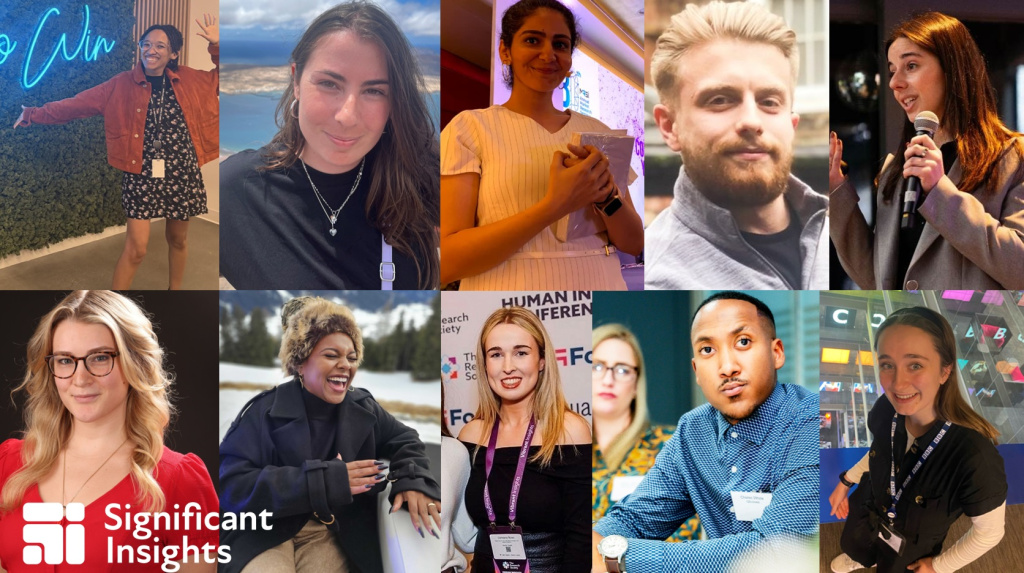
What the stories of the 2025 Global 30 Under 30 tell us about the next generation of insight leaders
One of the most striking themes across this year’s Global 30 Under 30 cohort is just how differently each honouree arrived in the industry. Few started their academic or early professional lives imagining they would one day become insight leaders. Yet when you look beneath the surface of their career stories, a shared driver emerges again and again: a deep, persistent curiosity about people.
Whether they come from psychology, business, public health, STEM, data science or even completely unexpected disciplines, these young leaders were pulled into insights through the same gravitational force — the desire to understand how people think, feel, behave and decide. And in an industry built on decoding human complexity, curiosity isn’t just useful; it’s foundational.
Curiosity as the Common Thread
Many of this year’s honourees describe early experiences that sparked their fascination with people. For some, it was a single research methods class that unexpectedly ignited a passion for asking questions. For others, it was a volunteer project, a marketing internship, or a behavioural science module that opened their eyes to the power of insight.
What they share is not a predetermined route, but the instinct to explore rather than accept things at face value. They ask why? when others move on. They notice patterns others overlook. They dive into complexity instead of shying away from it.
Curiosity becomes the entry point, and later, the accelerant, for a career in understanding people.

A Remarkably Diverse Set of Beginnings
If curiosity is the thread, the tapestry it weaves is astonishingly diverse.
Across the cohort, we see:
- Psychology graduates driven by an interest in cognition and behaviour.
- Business and marketing students fascinated by consumer decision-making.
- Social science and policy backgrounds grounded in understanding communities and societal trends.
- STEM and data specialists drawn to uncovering patterns and building insight from complexity.
- And individuals who began in completely different domains, healthcare, sales, operations, only to discover research through a chance encounter.
Their stories dispel any myth that there is a “correct” route into insights. The industry thrives precisely because it welcomes different lenses, disciplines and worldviews. And the future of the insights profession will depend on protecting that diversity.

The Turning Point: When Curiosity Becomes a Career
In many profiles, a pivotal moment appears, the instant when an interest becomes a calling.
For some, it was the excitement of seeing research influence real decisions in business or social impact.
For others, it was the first time they conducted a piece of qualitative research and felt the power of listening deeply.
For the quant-leaning honourees, it might have been turning a dataset into a story that changed a room.
These aren’t stories of people stumbling into insights; they are stories of people recognising that this is where their curiosity finally makes sense, where there is space to explore, learn and understand people at scale.

Why Curiosity is an Insight Leader’s Superpower
The modern insights industry demands more than technical skill. It demands:
- The imagination to see possibility.
- The sensitivity to understand people.
- The tenacity to uncover deeper truths.
- The intellectual flexibility to connect dots across domains.
Curiosity sits at the centre of all of these. It is the quality that turns questions into breakthroughs, and analysts into leaders. And it is the one trait you see consistently in the stories of the Global 30 Under 30.
As AI reshapes the landscape, curiosity becomes even more important, because while machines can process information, only humans driven by genuine interest can interpret meaning, nuance and emotion.
Lessons for the Next Generation of Insight Professionals
The journeys of the 2025 honourees carry clear messages for anyone at the start of their career:
1. You don’t need a pre-planned path, you need a mindset.
Curiosity will open doors that a traditional CV cannot.
2. Your background is never a limitation.
Insights absorbs and elevates diverse skill sets. What you bring from outside the industry may be your greatest advantage.
3. Nurture your curiosity deliberately.
Follow the questions that excite you. Seek roles that give you room to explore, not just execute.
4. Remember that insights is about people, not just data.
The most successful professionals in this cohort are those who blend analytical skill with a genuine interest in human stories.
A New Generation, Defined by Curiosity
What the 2025 Global 30 Under 30 demonstrate is simple but powerful: insight careers are rarely “chosen” in the traditional sense. They emerge from a mindset, one that values inquiry over certainty and exploration over assumption.
It is this mindset that will define the next era of insight leadership.
And it is why the industry is in good hands.